Most people shopping for concrete work compare three bids and pick the middle one. That's not a bad instinct, but the bids themselves rarely tell you what you need to know. A low number usually means something got skipped, and it's almost never the part you'd notice until the slab is already cracking.
Here's what actually separates a contractor who knows this area from one who's just pouring the same driveway they'd pour anywhere.
Ask about the ground before you ask about price
Redwood City isn't one soil type, it's several. Down near Redwood Shores and along the Bayfront, a lot of ground is fill sitting over old bay mud, which holds water and settles unevenly over years. Up in the hills, Emerald Hills and parts of Farm Hill sit on clay that swells when it's wet and shrinks hard in the dry months, which is exactly the kind of movement that cracks a slab poured without the right base or the right joints. A contractor who's worked here should be able to tell you, without checking a soil report, whether your street tends to need extra base rock or a moisture vapor barrier under the slab. If they don't ask about your soil at all, that's a gap.
Older neighborhoods like Mount Carmel and Friendly Acres were built mostly in the 1940s through the 60s, and a lot of that original concrete has been shifted for decades by street tree roots, mostly liquidambar and old oak. If you're doing a walkway or sidewalk repair on one of these lots, the contractor needs to plan for root intrusion coming back, not just pour a fresh panel over the same problem.
Licensing, and what the city actually checks
Any concrete contractor working on your property in California needs a C-8 concrete license or an equivalent general contractor license, and you can verify that number on the CSLB website in about thirty seconds. Ask for it. A legitimate contractor gives it to you without hesitation.
For work that touches the sidewalk, curb, or driveway apron, you're in the public right-of-way, and that means an encroachment permit through the city, separate from the building permit for the slab itself. Redwood City's Building Division also runs inspections at specific points, usually before the pour to check rebar placement and forms, and sometimes after. If a contractor tells you permits aren't necessary for a driveway or a retaining wall over a few feet tall, they're either wrong or hoping you won't ask again. If your property is in unincorporated San Mateo County, like parts of Emerald Hills, the permit goes through the county instead of the city, and that's worth confirming up front so nobody's guessing later.
What a real bid actually spells out
A bid that just says "4 inch slab, $X" isn't a bid, it's a guess. What you want to see written down:
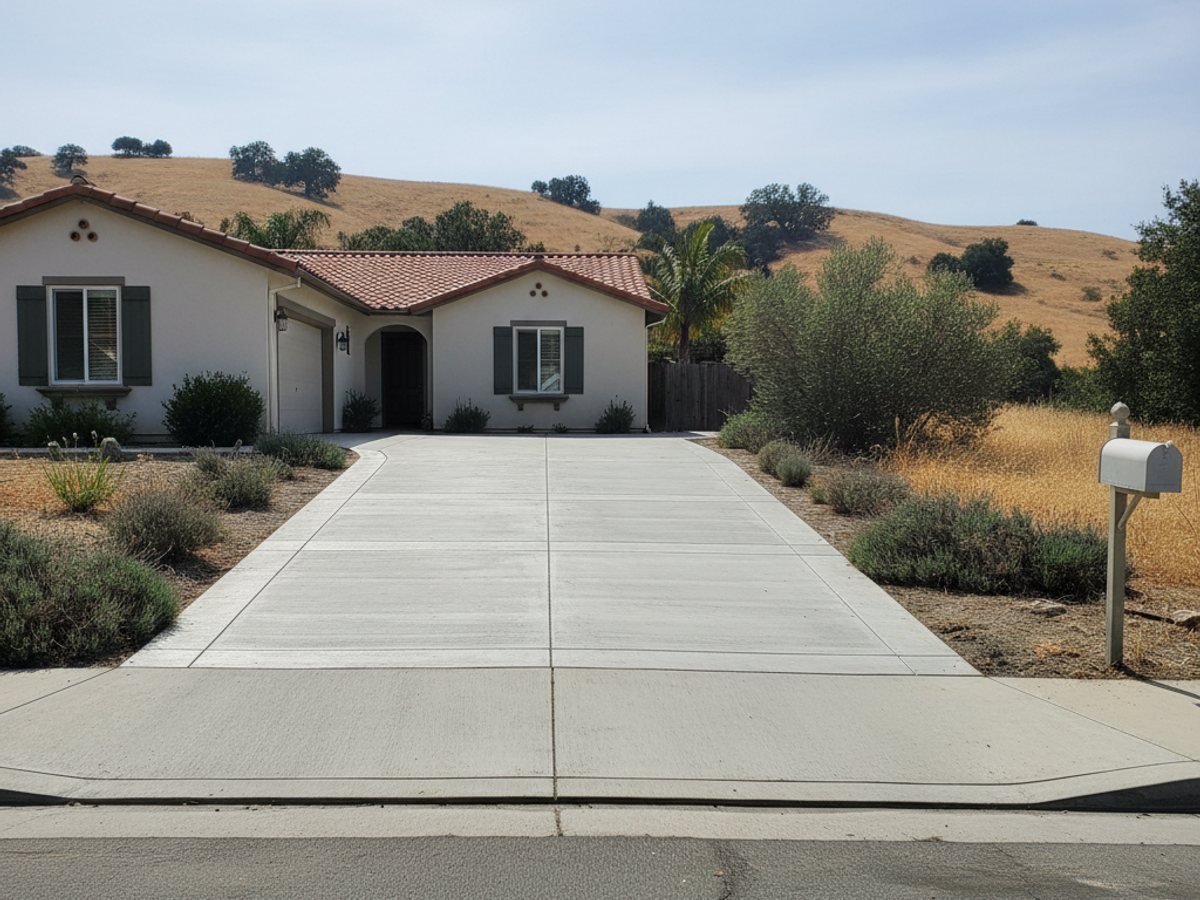
- Slab thickness, and it should match the load. Walkways and patios are usually 4 inches. A driveway that's going to carry a car or a truck should be 5 to 6 inches, especially near the street where delivery trucks turn.
- Base prep. That means compacted base rock, typically 4 inches minimum, more on soft or fill soil. Skipping this is the single most common shortcut, and it's invisible once the concrete's down.
- Reinforcement. Rebar on an 18 to 24 inch grid holds up better under vehicle weight than wire mesh, which tends to sink to the bottom of the pour if nobody holds it up during placement. Mesh is fine for a lot of patios. It's not fine for a driveway.
- Control joints. These get saw-cut within 6 to 24 hours of the pour, at roughly a quarter of the slab's depth, spaced to give the concrete a place to crack on purpose instead of wherever it wants to.
- PSI rating for the mix. 3,000 PSI concrete is standard for most residential flatwork here. Driveways and anything getting heavy traffic should be 3,500 or higher.
If a bid doesn't mention any of this, ask. If the contractor can't answer without looking it up, that tells you something too.
Red flags worth walking away from
A bid that's dramatically lower than the others is usually low because the base prep is thin, the rebar spacing is wide, or the slab is thinner than it should be. None of that shows up until year two or three.
Cash-only pricing with no written contract is a problem, full stop. So is a contractor who wants full payment up front before any work starts, no permit pulled, and no mention of inspections. And be cautious of anyone who tells you they can pour in the rain without changing anything about the process. They can pour in light rain if they know what they're doing, but it changes the mix and the finishing schedule, and a contractor who shrugs that off either doesn't understand it or doesn't care.
Timing matters more here than people think
Redwood City's dry season runs roughly May through October, and that's the window most contractors here prefer for pours, since curing concrete doesn't want to fight standing water or a soaked subgrade. Rainy season, November through March, brings the risk of a pour getting rained on before it sets, or water pooling against forms. We don't get real freeze-thaw cycles here, maybe a frost morning or two in January, so that's one less thing to worry about compared to inland areas. The marine layer and summer fog actually help slow the cure a little in the hot months, which isn't a bad thing for surface strength.
Once it's poured, you can usually walk on a slab after 24 to 48 hours. Driving a car on it takes about 7 days. Full strength, the number engineers actually design to, takes 28 days. Any contractor promising you can park a car on a driveway the next morning is either wrong or not planning to be around when it cracks.
A good contractor will walk your lot, ask about the soil, tell you what permits apply to your address, and put the thickness, base, reinforcement, and joint spacing in writing before you sign anything. If you want to see how we handle that process on driveways, patios, walkways, and repair work around Redwood City, you can look through Neighborly Concrete Solutions and see what we'd put in your bid.